You've read the sodium chapter three times. You can recite that normal serum sodium is 135–145 mEq/L. And then a question gives you a confused, restless patient with a sodium of 122, asks what you do first, and your mind goes blank. The number didn't help. The memorized range didn't help.
Here's the thing nobody tells you clearly: fluids and electrolytes don't reward memorization. They reward a picture. Once you can see where the water goes and what each ion is actually doing in the body, the questions stop feeling like a guessing game. By the end of this, you'll be able to look at a sodium or potassium value and know — not guess — what the body is trying to tell you and what comes first.
Let's build the picture.
Water Follows Salt — That One Rule Unlocks Half of Fluid Balance
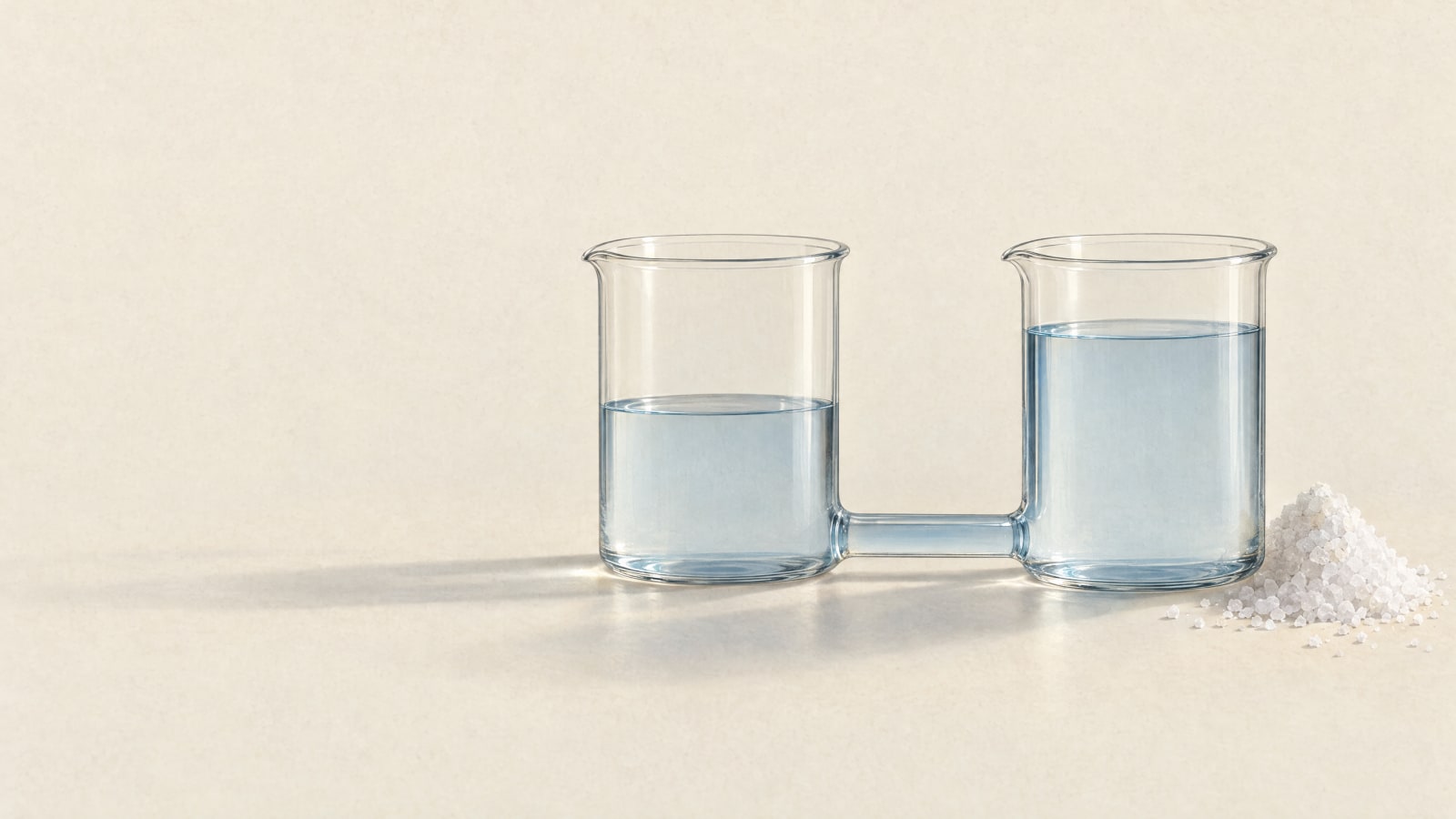
Forget the equations for a second. The single most useful idea in this whole topic is this: water goes wherever sodium goes.
Sodium is the body's main "pull." It lives mostly in the fluid outside your cells (the extracellular space — blood and the fluid bathing the tissues). Where sodium concentrates, water is drawn to follow, trying to keep both sides of the cell membrane balanced.
So when you see a sodium problem, don't ask "how do I fix this number?" Ask "where is the water right now, and where is it being pulled?"
- High sodium (hypernatremia, >145): there's too much salt relative to water — usually because the patient lost water or didn't take in enough. Water gets pulled out of the cells to dilute all that sodium in the blood. Brain cells shrink. That's why a dehydrated elderly patient or someone with a high sodium gets restless, then confused.
- Low sodium (hyponatremia, <135): the blood is too watery relative to salt. Water shifts into the cells, including brain cells. They swell. That's why your hyponatremic patient is confused, has a headache, and — if it drops far or fast enough — can seize.
Notice the pattern: both extremes mess with the brain, because both move water across the cell membrane. The direction of the water tells you the symptoms.
The bedside rule: sodium is a water problem first. A sodium of 122 isn't really a salt-shortage story — it's usually a too-much-water story. That single reframe answers a surprising number of questions correctly.
Potassium Lives Inside the Cell — and It Runs the Heart
If sodium is the outside ion, potassium is the inside ion. Almost all of your body's potassium sits inside your cells. Only a thin sliver floats in the blood — and that sliver is what your lab value measures (normal 3.5–5.0 mEq/L).
Why does such a small range matter so much? Because that tiny amount of potassium in the blood sets the electrical excitability of muscle — and the most important muscle you have is the heart.
Here's the picture that makes potassium click: think of potassium as the volume knob on your heart's electrical signal. Too low, too high — either way, the rhythm goes wrong.
- Low potassium (hypokalemia, <3.5): muscles get sluggish and weak. The whole body goes "flat" — weak, fatigued, decreased reflexes, and on the heart, a flattening of the rhythm that can slide into dangerous arrhythmias. Think down and slow: weak muscles, weak gut (constipation, slowed bowel), and a heart that can start skipping.
- High potassium (hyperkalemia, >5.0): the heart becomes too excitable, then dangerously unstable. Peaked T-waves on the rhythm strip are the classic early warning, and it can progress to a lethal rhythm fast. Think too much spark.
The takeaway that travels into every NCLEX question: potassium is a cardiac problem. When you see an abnormal potassium, your mind should go straight to the heart and the monitor — not to the muscles, not to the labs to recheck later. The rhythm is what kills, so the rhythm is what you watch.
Get free NCLEX-RN study tips
The highest-yield NCLEX-RN prep, in plain English, a few minutes a week.
By subscribing you agree to receive emails from HLT Mastery.
- Weekly, never noisy
- One short email a week — the highest-yield concept to review and a practice question to test yourself.
- No spam, no sharing
- Prep for your exam. Unsubscribe in one click, and we never share your email.
When Two Answers Look Right, Ask "What's Most Dangerous?"
This is where fluids and electrolytes questions actually trip people up — not the facts, the priority. You'll often get four options that are all technically reasonable. The exam isn't testing whether you know the facts; it's testing whether you know what threatens the patient first.
Use this order, every time:
- Is the airway or breathing affected? (Severe imbalances can cause weakness that impairs breathing.)
- Is the heart unstable? Any significant potassium abnormality, or a fast/severe sodium change, goes here. Get the patient on a cardiac monitor.
- Is the brain affected? New confusion, seizures, restlessness from a sodium shift.
- Then the teaching, the diet changes, the rechecks, the documentation.
So when a question gives you a hyperkalemic patient and asks what to do first, the answer isn't "administer the medication that lowers potassium" or "teach the low-potassium diet" — useful as those are. It's whatever protects the heart right now: assess the patient, get them monitored. Stabilize first, treat second, teach last.
That ordering — stabilize before you treat, treat before you teach — resolves the majority of "which is the priority" electrolyte questions. The trap answer is almost always a correct action that simply isn't the most urgent one.
Connect the Dots: Why Potassium and Sodium Don't Travel Alone
One more layer, because it's where the higher-level questions live. These imbalances rarely happen in isolation, and the body's pumps tie them together.
A classic one to lock in: many diuretics that pull off extra fluid also pull off potassium with it. So a patient on a potassium-wasting diuretic isn't just losing water — they may be quietly dropping into hypokalemia. Pair that with a heart medication that's sensitive to potassium levels, and you have exactly the kind of layered scenario the exam loves to build.
You don't need to memorize every interaction. You need the habit of asking: if the body is losing fluid, what electrolyte is going with it? If sodium is off, what happened to the water? If potassium is off, what's the heart doing?
That habit — chasing the why instead of the number — is the difference between a student who freezes and a nurse who reasons.
What to Carry Into the Exam
Strip everything down to four pictures and you're carrying more than a chapter of notes:
- Water follows sodium. A sodium problem is a water problem — ask where the water is being pulled, and the symptoms (especially the brain ones) follow.
- Potassium runs the heart. It lives inside the cell; the small amount in the blood controls the rhythm. Abnormal potassium means: watch the monitor.
- Both sodium extremes hit the brain; both potassium extremes hit the heart. Direction of the shift tells you the signs.
- When two answers look right, pick the most dangerous one. Stabilize, then treat, then teach.
You don't have to know everything at once. Pick one of these pictures, run a handful of practice questions through it, and notice how the reasoning starts to feel automatic. That's the goal — not a memorized range, but a mental model you can apply to a question you've never seen before.
When you're ready to test whether the picture holds up under pressure, work through fluid-and-electrolyte questions with the rationale walked out step by step — the kind that show you not just the right answer, but why the tempting wrong one was a trap. That's where this clicks for good.
A quick honest note: the specific normal lab ranges and any drug names above are the standard teaching values, but always confirm against your current course materials and the most recent NCSBN test plan before test day — reference ranges and exam framing get updated, and you want to study the current version.