
NCLEX Mastery
\
Apr 2, 2026
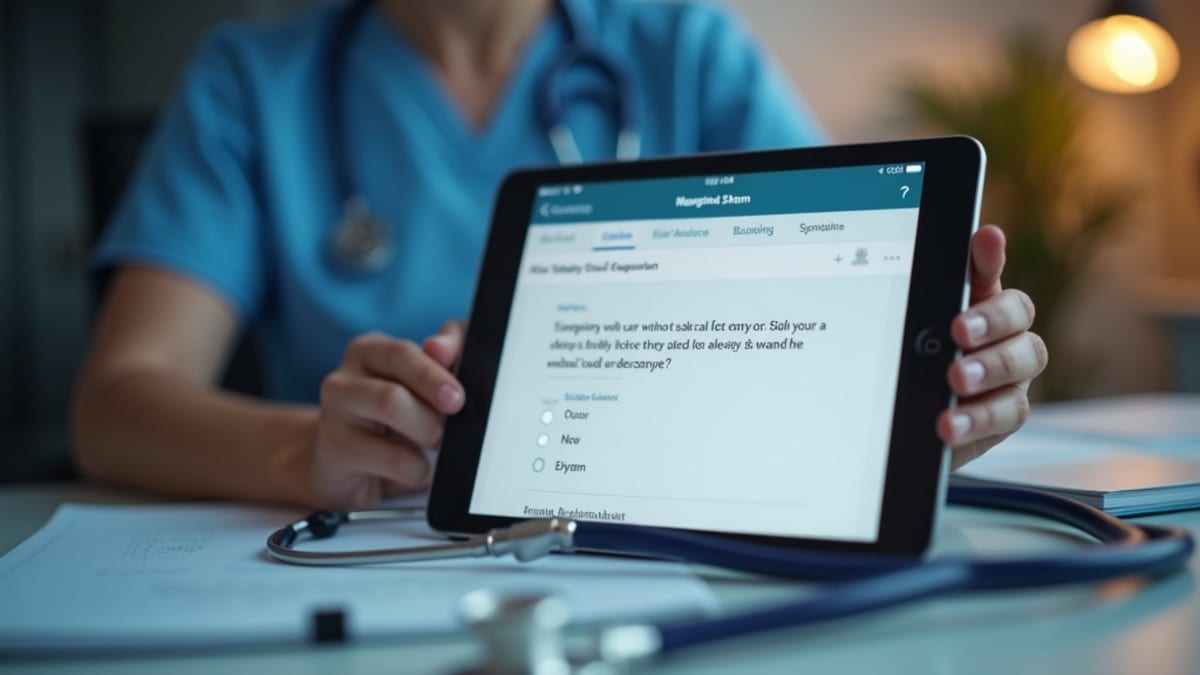
NCLEX isn't asking you to recall facts. It's asking you to think like a nurse.
That's why memorizing drug names won't save you. Why reading textbook chapters for eight hours won't guarantee a pass. Why your grandma's "just relax" advice doesn't help.
The exam has a very specific architecture. Once you understand it, every question becomes predictable. Even the ones you've never seen before.
The 5 Traditional NCLEX Question Types
Question Type | What It Tests | Strategy |
|---|---|---|
Multiple Choice | Priority and best action | Eliminate two, then compare the remaining two |
SATA | Comprehensive knowledge | Evaluate each option independently as true/false |
Drag-and-Drop | Sequencing and priority | Think nursing process: assess, plan, implement, evaluate |
Hotspot | Anatomy and visual identification | Know your landmarks. Practice with images |
Case Study (NGN) | Clinical judgment across a scenario | Follow the NCSBN Clinical Judgment Model steps |
1. Multiple Choice (Standard)
Four options, one answer. Seems simple. It's not.
The stem is a scenario. The correct answer isn't the "most textbook-correct" answer—it's the answer a competent nurse would choose in that moment. Which is different from the answer a student memorized.
Example logic: "A patient is on digoxin. Which sign suggests toxicity?"
Textbook answer: hypokalemia (correct). But NCLEX might say "hypokalemia AND which of these also indicates toxicity?" to test whether you know digoxin toxicity is multi-system.
2. Select All That Apply (SATA)
Multiple correct answers. No partial credit in traditional NCLEX (you either get it all right or get no points). This terrifies students.
The trap: students think "select all that sound right." Instead, think "treat each option as true or false independently."
One option can be true and still not correct for the question. Example: "Which of these are signs of sepsis?" Fever is a sign of sepsis (true), but if the question asks "which contraindicate antibiotics?" fever doesn't contraindicate antibiotics. So you don't select it.
3. Drag and Drop
Organize items in order (usually priority or sequence). Example: "Put these nursing interventions in priority order for a patient with acute MI."
The test isn't whether you know interventions exist. It's whether you know which comes first based on clinical judgment and ABC's (Airway, Breathing, Circulation).
4. Hot Spot
Click a location on an image (ECG strip, assessment diagram, etc.). Example: "Click the area where you'd place the chest leads for an ECG."
Testing image interpretation and procedural knowledge. Simple format, but requires precision.
5. Fill in the Blank
Usually dosage calculations or short numerical answers. Example: "A patient weighs 80 kg. Drug is dosed at 2 mg/kg. How many mg total?"
No multiple choice safety net. You either calculate correctly or you don't. The test is math accuracy and unit conversion, not clinical judgment.
NGN Question Types (New Generation NCLEX Added in 2023)
The NCSBN overhauled NCLEX in 2023 to focus more on clinical judgment. These are the additions:
Bowtie/Multiple Response Grouping
A clinical scenario with multiple response windows. Each response window has different options. Example: "Patient presents with chest pain. What assessment findings indicate ACS vs anxiety?"—then separate response sets for "findings suggesting ACS" and "findings suggesting anxiety."
You might select two findings for ACS, three for anxiety, depending on what the patient shows.
Trend Analyzing
Lab values or vital signs over time. You have to recognize the pattern.
Example: Potassium levels over three days: 4.8, 5.2, 5.6. The trend suggests hyperkalemia is worsening. What's your next action?
Testing: Can you see a problem developing before it's a crisis? That's nursing.
Cloze (Fill in the Blanks in Context)
A paragraph with blanks. You fill in words from a dropdown menu.
Example: "The patient is experiencing _____ (severe pain / mild discomfort / no pain). The priority nursing action is to _____ (assess pain severity / administer analgesia / reassure the patient)."
Testing whether you prioritize correctly within a scenario.
Unfolding Case Study
A scenario that evolves. First question asks for your assessment of the initial presentation. Based on your response, the case unfolds differently. Example: "Patient presents with shortness of breath. What's your first assessment?" Your answer determines what happens next—new vital signs, new lab values, new complications.
Testing: Can you adapt to new information? Do you reassess when conditions change?
What Clinical Judgment Actually Means
NCLEX isn't testing knowledge anymore. It's testing clinical judgment. Here's what that means:
Not: Knowing the textbook definition of sepsis.
But: Recognizing fever + tachycardia + hypotension in a post-operative patient and thinking "This could be sepsis. I need to escalate immediately."
Not: Memorizing digoxin side effects.
But: Seeing a patient on digoxin with nausea, visual disturbances, and arrhythmia—and concluding "Toxicity. I need to check the level and notify the provider."
Not: Knowing that ABCs is priority framework.
But: Taking a patient with altered mental status, assessing airway patency, then breathing, then circulation—and knowing which intervention happens first.
The "Nurse Thinking" Framework
Every NCLEX question, no matter the type, tests this sequence:
Assess: What's happening right now? (Clinical findings, vital signs, patient state.)
Recognize: What pattern is this? (Disease process, medication effect, normal variation?)
Prioritize: What matters most in this second? (ABCs, pain, safety, escalation?)
Act: What do I do? (Assess more, intervene, notify, delegate?)
Evaluate: Did it work? (Is the patient safer? Is the problem solved or escalating?)
If you apply this framework to every question—multiple choice, SATA, trend analysis, case study—you'll be thinking like the exam expects you to think.
Key Insight: Every NCLEX question tests clinical judgment — not memorization. The exam is looking for evidence that you can think through a patient scenario and choose the safest action, not that you memorized a textbook answer.
How to Read an NCLEX Stem Like a Pro
Read the entire question first. Don't stop at the first answer choice.
Identify: What's the scenario? What's the patient state? What's being asked?
Then eliminate answers that don't fit the scenario. Most eliminations happen before you need deep clinical knowledge.
Look for the "most nursing" answer. Not the most medical, not the most textbook. The answer a competent bedside nurse would choose.
Don't over-interpret. "The patient hasn't eaten in 8 hours" probably doesn't matter unless the question is about NPO status. Don't read hidden meaning into every detail.
Keep Reading
Want to practice every question type covered here — SATA, drag-and-drop, case studies, hotspot — in an environment that mirrors the real exam? NCLEX RN Mastery has 4,000+ adaptive questions with detailed rationales. Ten free daily.
Final Word
NCLEX tests how you think under uncertainty. You'll never know every answer. You're not supposed to. You're supposed to apply judgment when you don't know, recognize patterns when you do, and prioritize safety always.
Spend less time memorizing. Spend more time thinking like a nurse. The exam will follow.
NCLEX Mastery
\
How to Interpret ABGs for the NCLEX
How to Interpret ABGs for the NCLEX

NCLEX Mastery
\
Estimating TBSA: What Every Nurse Should Know
Estimating TBSA: What Every Nurse Should Know

Catherine Cantrell, MSN, RN
\
What Actually Happens When You Fail a Nursing Course