
NCLEX Mastery
\
Apr 27, 2026

The burn unit was the one place I never wanted to float to in the hospital.
It was all-ages at the hospital where I worked. As you can imagine, in a unit where every situation was difficult, some of the pediatric cases were incredibly heartbreaking.
I have a lot of respect for nurses and CNAs who care for clients with burns. It is a very difficult job to know you must inflict necessary pain on someone in order to help them recover from a serious injury.
You will want to know two rapid assessment tools cold: the rule of nines for adults and the rule of palms. Both are used to estimate total body surface area (TBSA), and that number drives everything that happens next.
Why Does TBSA Matter in Burn Care?
TBSA is not just a percentage on a chart. It is the clinical data point that determines whether a patient gets transferred to a burn center, and it is the foundation for calculating fluid resuscitation in the first 24 hours. Without an accurate TBSA estimate, you cannot calculate what your patient needs to survive the acute phase of a burn injury.
For the NCLEX, TBSA is high-yield because it connects directly to two testable skills: (1) recognizing when a patient requires a higher level of care, and (2) understanding the framework behind burn fluid replacement. You do not need to calculate the Parkland formula to the milliliter on the exam, but you do need to understand that TBSA is what drives it.
What Burns Count Toward TBSA?
This is where students lose points, both in the classroom and on the NCLEX.
Only partial-thickness burns (second-degree) and full-thickness burns (third-degree) are counted when calculating TBSA. Superficial burns, also called first-degree burns, involve only the outer layer of the epidermis. They are not included in TBSA calculations.
If you see a burn description on the NCLEX and one of the affected areas is superficial, leave it out of your math.
Rule of Nines (Adult)
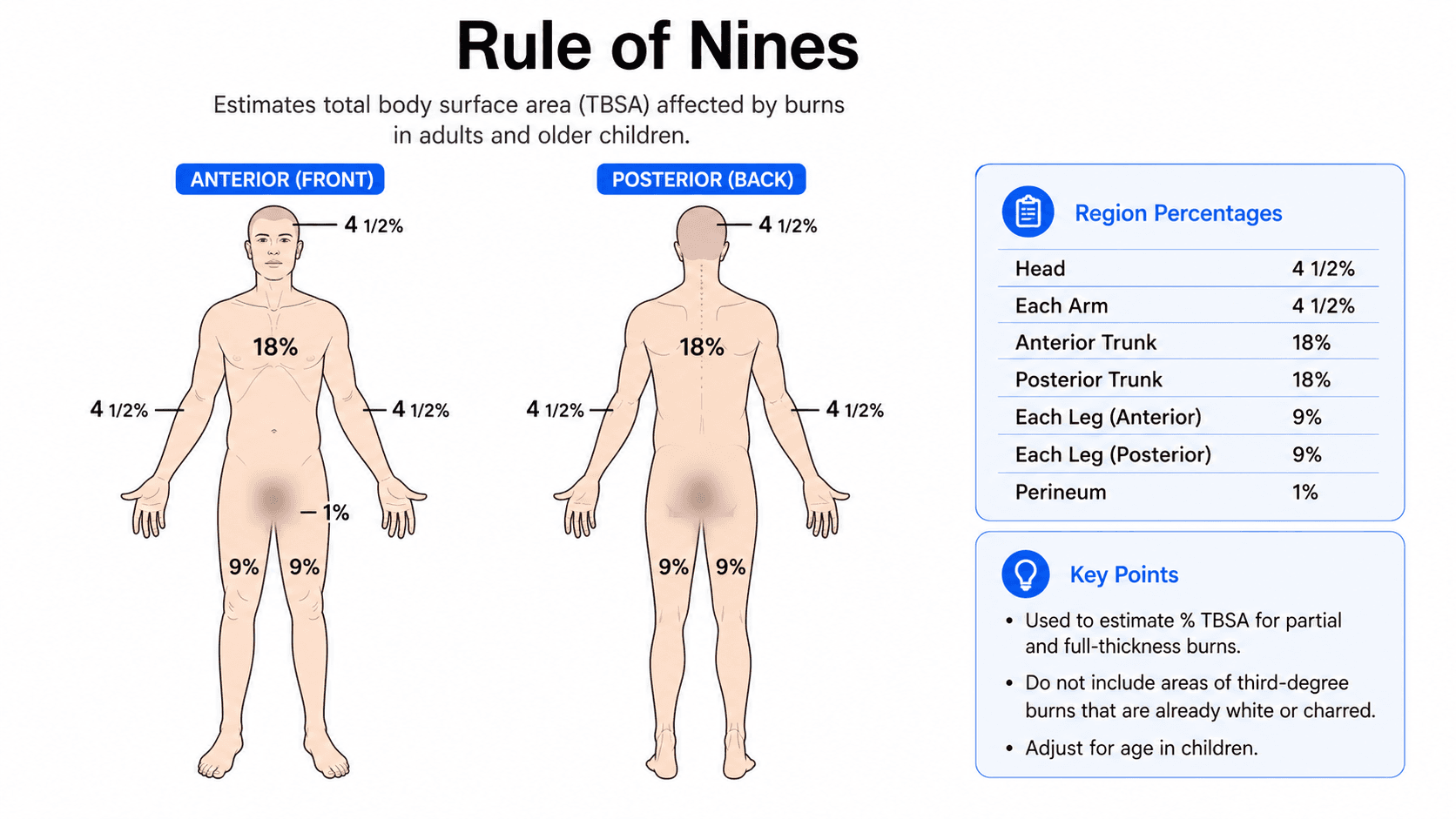
The rule of nines divides the adult body into regions, each representing 9% of TBSA or a multiple of 9%, totaling 100%.
Head and neck: 9%
Anterior trunk (chest and abdomen): 18%
Posterior trunk (back): 18%
Each arm (entire): 9% (4.5% anterior, 4.5% posterior)
Each leg (entire): 18% (9% anterior, 9% posterior)
Genitalia/perineum: 1%
The arm calculation is a consistent source of confusion. Each arm accounts for 9% only when both the anterior and posterior surfaces are burned. If only one surface is involved, the percentage is 4.5%. Read burn descriptions carefully before calculating.
Rule of Palms
The rule of palms uses the surface area of the patient's own palm — fingers held together — to estimate approximately 1% of TBSA. It is most useful for burns that are small, scattered, or irregular in shape, where the rule of nines is difficult to apply cleanly.
Use the patient's palm, not your own.
A Note on Pediatric Patients
The rule of nines is an adult tool.
It does not apply accurately to infants and young children because body proportions are different. The head represents a significantly larger percentage of surface area in young children, and the legs represent less. The Lund-Browder chart is the more accurate tool for pediatric burn assessment because it accounts for age-related body proportion changes.
The NCLEX may not ask you to calculate pediatric TBSA, but it will expect you to know that adult percentages do not apply to children.
What Comes After TBSA: The Clinical Picture
TBSA feeds directly into the decision to transfer a patient to a burn center and into the calculation of fluid resuscitation requirements for the first 24 hours. The Parkland formula uses TBSA and the patient's weight to determine the volume of lactated Ringer's solution given over the first 24 hours, with half administered in the first 8 hours and the remainder over the following 16.
Knowing TBSA is step one. It is not the only step, but without it, none of the steps that follow are possible to perform accurately.
What to Know Cold for the NCLEX
Only partial-thickness and full-thickness burns count toward TBSA
The Lund-Browder chart is used for pediatric patients
The rule of nines applies to adults
Each arm is 9% only if both surfaces are burned
Each surface alone is 4.5%
Each leg is 18% total (9% anterior, 9% posterior)
The rule of palms estimates 1% TBSA using the patient's own palm
TBSA drives burn center transfer decisions and fluid resuscitation calculations
NCLEX Mastery
\
How to Interpret ABGs for the NCLEX
How to Interpret ABGs for the NCLEX
NCLEX Mastery
\
Estimating TBSA: What Every Nurse Should Know
Estimating TBSA: What Every Nurse Should Know

Catherine Cantrell, MSN, RN
\
What Actually Happens When You Fail a Nursing Course